
Reduce CHW Attrition With a Community Health Worker SMS System That Scales
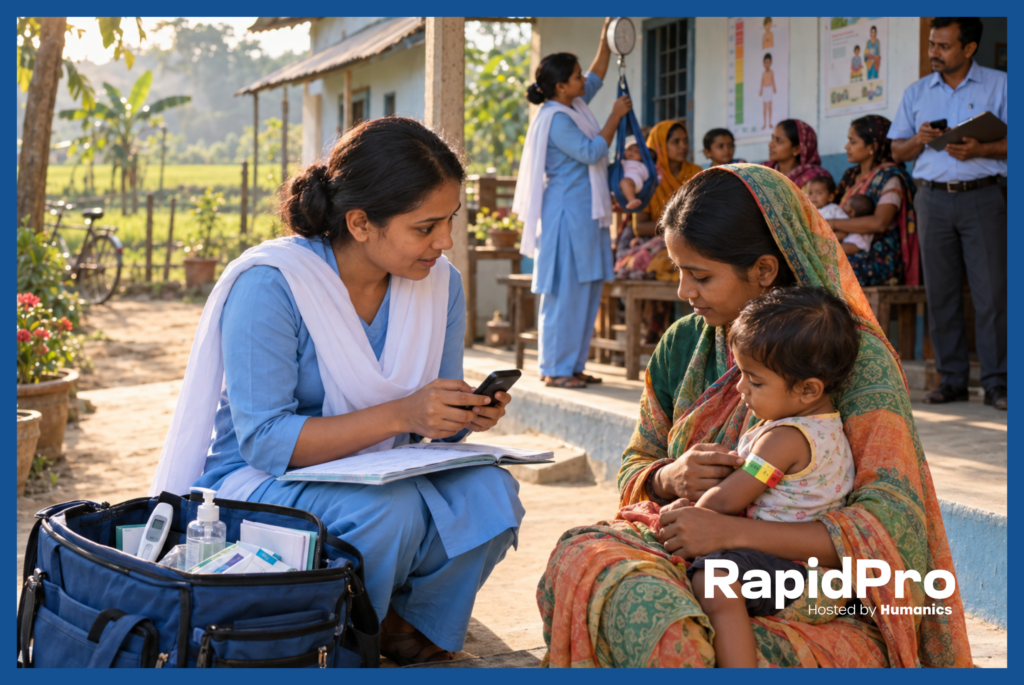
Community Health Worker
In Dhaka’s urban slums, BRAC enrolled 542 volunteer community health workers in a maternal and child health project. Of the 542 CHWs originally enrolled, 120 dropped out within one year (Alam & Oliveras, Human Resources for Health, 2014). That is more than one in five trained workers lost within twelve months.
Every departure erases training costs, community trust, and continuity of care. Many CHWs leave because they work alone, with little supervision and no feedback on their work.
A well-designed community health worker SMS system closes that gap. It keeps supervisors, peers, and facilities in contact with CHWs on any basic phone. Below are seven SMS workflows you can deploy this quarter, with the logic behind each one.
A community health worker SMS system is a two-way text messaging setup that connects CHWs with supervisors, health facilities, and supply chains. In practice, it automates routine reporting, alerts, reminders, and feedback, so CHWs in remote areas stay supported without needing a smartphone or internet access.
Why Isolation Drives CHW Attrition, and What a CHW Communication Platform Changes
Attrition rarely has a single cause. Pay, workload, and family pressure all play a role. However, research consistently points to support structures as a factor programs can control.
A review in the Bulletin of the World Health Organization lists the factors linked to retention, including supportive supervision, defined roles with specific tasks, locally relevant incentives, incentive systems combining monetary and nonmonetary benefits, recognition, and training opportunities. Most of these depend on regular contact between the CHW and the wider program.
The supervision gap in remote programs
A supervisor covering 30 villages cannot visit each CHW every week. Fuel, roads, and time make it impossible. As a result, many CHWs go weeks without hearing whether their reports matter.
Why a CHW communication platform should start with SMS
A CHW communication platform built on SMS reaches every worker, not only those with smartphones. Basic phones hold charge for days, work on 2G networks, and cost little to replace.
SMS also requires no training beyond reading and typing short replies. For low-literacy contexts, the same flows can run over voice (IVR). Where coverage allows, programs can add WhatsApp or Telegram without rebuilding their logic.
That silence has a cost. CHWs who receive no feedback stop reporting. Programs that stop receiving reports stop noticing who needs help.
7 SMS Workflows That Keep mHealth Community Health Workers Connected
Each workflow below targets a specific cause of isolation or disengagement. Together, they form the backbone of a mature mHealth program for community health workers.
1. Weekly activity reporting with automated completeness tracking
Every Monday, the system sends each CHW a short structured prompt: households visited, pregnancies registered, children under five assessed. The CHW replies with numbers.
The flow validates each answer instantly. If a number is out of range, it asks again. Missing reports trigger a reminder after 24 hours, then a supervisor alert after 48. Supervisors see completeness rates per district without chasing anyone.
2. Stock-out alerts triggered by supply level responses
CHWs report stock levels of key commodities, such as ORS, zinc, malaria RDTs, and contraceptives. When a reply falls below a set threshold, the system notifies the district pharmacy automatically.
This matters for retention. A CHW without supplies loses credibility with the community. Fixing stock-outs quickly protects the trust that keeps CHWs motivated.
3. Patient referral confirmation and follow-up loops
When a CHW refers a patient, they send a short code to the system. The receiving facility gets a notification. Once the patient arrives, the facility confirms by SMS, and the CHW receives a message closing the loop.
If no confirmation arrives within 72 hours, the CHW receives a prompt to follow up with the household. CHWs finally see the outcome of their referrals, which reinforces the value of their work.
4. Supervisory check-in with escalation for non-response
Every two weeks, CHWs receive a check-in: “How are things going? Reply 1 = fine, 2 = need support, 3 = urgent problem.” A “2” schedules a supervisor call. A “3” alerts the supervisor immediately.
Silence is data too. If a CHW does not respond to two consecutive check-ins, the system flags them as at risk of dropping out. Supervisors can intervene before the CHW quietly disappears.
5. Training quiz and knowledge reinforcement sequences
After a training session, CHWs receive one multiple-choice question every few days over six weeks. Correct answers receive confirmation. Wrong answers receive a short explanation, and the question returns later.
This spaced repetition keeps skills fresh between in-person refreshers. Program managers also get a clear picture of which topics need retraining.
6. Peer motivation messages
Programs can send weekly messages that recognize collective progress: “This month, CHWs in your district registered 412 pregnancies. Thank you.” Top reporters can receive individual recognition.
CHWs can also be grouped by area, so announcements and encouragement reach the right peer network. Recognition is one of the cheapest retention tools available, and SMS delivers it at scale.
7. Danger sign triage protocol with automated facility notification
When a CHW identifies a danger sign, such as convulsions, severe bleeding, or fast breathing in a newborn, they start a triage flow. The system asks a short series of yes/no questions based on national protocols.
If the answers indicate an emergency, the nearest facility receives an alert with the patient’s location and symptoms. The CHW receives clear next steps. No CHW faces a life-threatening case alone.
Comparison: what each workflow solves
| Workflow | Isolation factor addressed | Primary recipient | Trigger type |
|---|---|---|---|
| Activity reporting | No feedback on work | Supervisor | Scheduled (weekly) |
| Stock-out alerts | Lack of supplies | Pharmacy/district | Response threshold |
| Referral loops | No visibility on outcomes | Facility + CHW | CHW-initiated |
| Supervisory check-in | Absent supervision | Supervisor | Scheduled + non-response |
| Training quizzes | Skill decay | CHW | Scheduled sequence |
| Peer motivation | Lack of recognition | CHW groups | Scheduled |
| Danger sign triage | Facing emergencies alone | Facility + CHW | CHW-initiated |
Discover how RapidPro App enables automated CHW supervision and reporting without managing servers → RapidPro for health programs · Request Your Demo →
How to Deploy a Community Health Worker SMS System in 6 Steps
You do not need to launch all seven workflows at once. Most programs start with reporting and check-ins, then add workflows as CHWs get comfortable.
Collect names, phone numbers, districts, and supervisors in a single spreadsheet.
Start where isolation hurts most, usually reporting and supervisory check-ins.
Test wording in local languages with a small group before scaling.
Validate every branch, including wrong answers and no response.
Run for four to six weeks and track response rates.
Extend to new districts, then layer in referrals, stock alerts, and triage.
Building your community health worker SMS system on RapidPro
RapidPro is the open-source messaging platform developed by UNICEF. It lets program teams design these workflows visually as “flows,” without writing code.
Several RapidPro features map directly to CHW needs.
Scheduled triggers send weekly reports and check-ins.
Wait-for-response nodes with timeouts power non-response escalation.
Contact groups segment CHWs by district or supervisor.
Webhooks push data to DHIS2 or other health information systems.
RapidPro also powers mHero, a health worker communication tool used by ministries of health. See how it supports CHWs in practice in our Uganda mHero case study.
Choosing channels for a community health worker SMS system
SMS remains the default for rural CHWs. However, the same flow can run across several channels. RapidPro supports SMS, voice, WhatsApp, Telegram, and others from a single workspace.
Many programs use SMS for CHWs and WhatsApp for supervisors. This keeps costs low at the community level and gives managers richer messaging. Hosting matters too: a managed platform removes server maintenance from your team’s workload.
✓ CHW programs lose a large share of trained workers within the first year, and limited supervision is a recognized contributing factor.
✓ A community health worker SMS system reaches every CHW on basic phones, without internet or smartphones.
✓ Seven workflows cover the main isolation gaps: reporting, stock alerts, referrals, check-ins, training, recognition, and emergency triage.
✓ Non-response tracking turns silence into an early warning sign for dropout.
✓ RapidPro lets program teams build these workflows visually and connect them to existing health information systems.
Frequently Asked Questions
How can SMS improve community health worker retention?+
SMS improves retention by giving CHWs regular contact with their program. Automated check-ins, feedback on reports, and referral confirmations show CHWs that their work matters. Supervisors can also detect disengagement early through non-response tracking and intervene before a CHW leaves.
What is the best communication platform for community health workers?+
The best CHW communication platform works on basic phones, supports local languages, and requires no coding to update. RapidPro meets these criteria and is used by UNICEF and ministries of health. It runs over SMS, voice, and messaging apps from the same workspace.
Can community health workers use SMS without a smartphone?+
Yes. SMS works on any mobile phone, including basic feature phones on 2G networks. CHWs reply with short numbers or keywords. For workers with limited literacy, the same workflows can run as voice calls with keypad responses.
How much does an SMS system for CHWs cost?+
Costs depend on three elements: platform hosting, SMS volume, and setup time. Message costs vary by country and operator. A managed hosting service with transparent pricing removes server and maintenance costs, which often make up a large share of self-hosted budgets.
Conclusion
CHW attrition is expensive, and isolation is one of its drivers you can act on. SMS reaches every worker, regardless of phone type or network quality. Seven targeted workflows turn scattered CHWs into a connected, supported team.
Keep Every CHW Connected, Without Managing Servers
A community health worker SMS system only works if it stays online, secure, and easy to update. RapidPro App provides fully managed RapidPro hosting, so your team focuses on flows and CHWs, not servers. It is the most affordable managed RapidPro solution on the market, with transparent pricing and no hidden fees.
If you are planning or scaling a CHW program, we would be glad to show you how these workflows run in practice.
Related Reading
National SMS Platform: Architecture and Compliance at Country Scale