
How to Choose Between IVR, SMS, and WhatsApp for Low-Literacy Populations
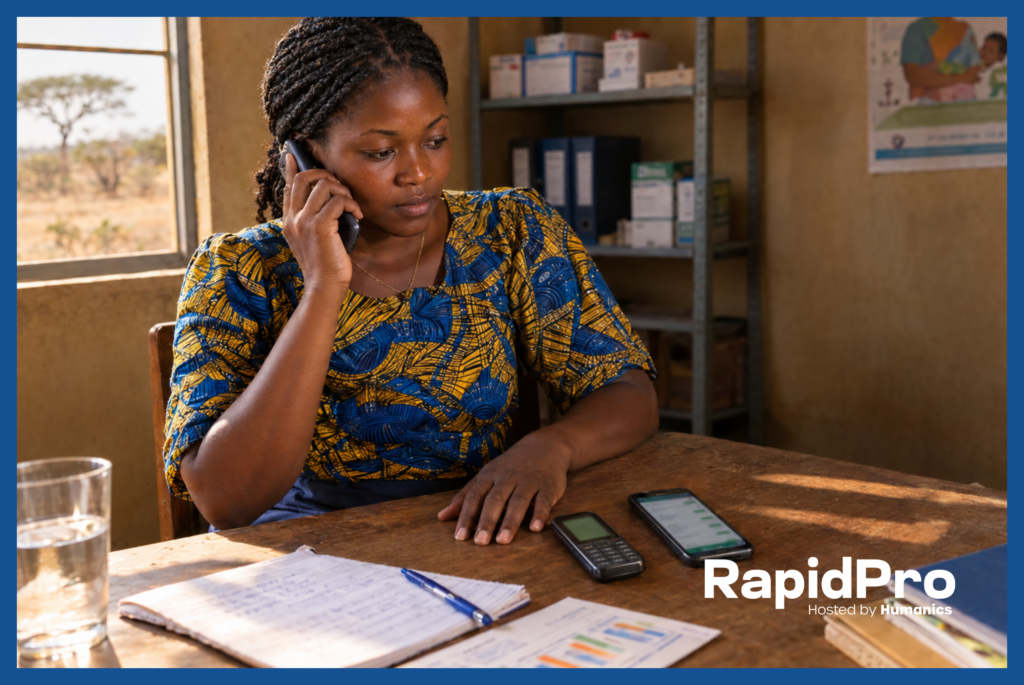
IVR vs SMS and WhatsApp for Low-Literacy Populations
A 2023 UNESCO report puts the global adult illiteracy figure at 763 million people. Most of them live in Sub-Saharan Africa and South Asia, the same regions where development programs depend on mobile messaging to reach beneficiaries.
Here’s the problem: most programs default to SMS. Program teams pick it because it’s cheap, it’s familiar, and every phone supports it. But when 40% of your target population can’t read the message you just sent, cheap delivery is expensive failure.
This guide gives you an eight-criteria decision framework for choosing between IVR, SMS, and WhatsApp in low-literacy contexts. Each channel gets a field-tested profile with real deployment examples. And because the channel question is a design decision that shouldn’t lock you into a single vendor, we show how a multichannel flow engine lets you route messages by contact attributes rather than rebuilding your program from scratch.
IVR (Interactive Voice Response) is a voice-based system where beneficiaries listen to pre-recorded audio prompts and respond by pressing keys on their phone’s keypad. In practice, this means a farmer in rural Niger can hear weather advisories in Hausa and confirm receipt by pressing “1,” with no reading required.
IVR vs SMS, WhatsApp for Low-Literacy Populations: The Decision Matrix
The literacy rate of your target population is the single strongest predictor of channel effectiveness. When adult literacy falls below 60% in your program area, IVR consistently outperforms SMS on comprehension, response rates, and message retention.
This is not theory. Three field patterns hold up across deployments.
A voice message in the beneficiary’s local language bypasses the literacy barrier entirely. No decoding written characters, no parsing templates designed for English-speaking program officers.
IVR works on every phone that can receive a call, including the $8 Nokia 105 that outsells every smartphone in Sub-Saharan Africa. No data connection. No app. No menu.
Health topics (HIV counseling, maternal health) benefit from voice delivery. Tone, pacing, and emphasis carry meaning that text strips out. Programs report higher completion rates with IVR.
Voice Messaging Development Programs in West Africa
Voice messaging development programs in West Africa have demonstrated this repeatedly. Viamo’s 3-2-1 service in Niger delivered agricultural advisories via IVR to 500,000+ users, the majority of whom had never sent a text message. Response rates averaged 78%, a number no SMS campaign in the same region came close to matching.
SMS also works on feature phones, but the advantage evaporates when the recipient can’t read. IVR keeps the interaction fully accessible.
A recorded voice saying “this is normal, and treatment is available” lands differently than the same words on a screen. Programs that handle sensitive health information consistently report higher completion rates with IVR over SMS.
When SMS Remains the Right Default
SMS gets a bad reputation in ICT4D circles, mostly because programs use it badly. But for the right audience and the right message type, SMS is still the most cost-effective channel available.
High-Literacy, Low-Data Environments
When adult literacy exceeds 80%, and smartphone penetration stays below 50%, SMS hits a sweet spot. The recipient can read. The phone supports it. No data costs apply.
Treatment adherence reminders for HIV/TB programs in Kenya run on SMS because the target population (urban and peri-urban adults on antiretroviral therapy) is literate, carries feature phones, and needs short, time-sensitive nudges. A two-sentence reminder at 8:00 AM costs less than $0.01 per message and generates consistent response rates above 60%.
Structured Data Collection
SMS handles structured responses (yes/no, numeric codes, short keyword replies) better than IVR. When your flow needs a beneficiary to reply “1” for yes and “2” for no, both channels work. But when you need a name, a registration number, or a date, SMS input is faster, cheaper, and less error-prone than IVR keypad entry.
Cost at Scale
IVR calls cost 3x to 10x more than SMS messages, depending on the country and carrier. For a program sending 500,000 messages per month, this difference is a budget line item, not a rounding error. If your audience can read, SMS saves money that goes toward program delivery instead of telecom fees.
Where WhatsApp Beats Both
WhatsApp occupies a different niche. It requires a smartphone and a data connection, which immediately limits its reach in the lowest-income settings. But where smartphones are present, WhatsApp delivers capabilities that neither IVR nor SMS can match.
Photo uploads, instructional videos, PDF documents, voice notes, location pins. Refugee registration in Jordan collected identity documents, family data, and GPS coordinates in a single WhatsApp flow.
WhatsApp’s chat interface makes multi-turn conversations feel natural. Beneficiaries reply in their own words rather than pressing keypad digits. Drop-off decreases, depth of data increases.
WhatsApp Business API supports template messages to segmented contact lists. A multichannel messaging NGO sends targeted health advisories to one group and market prices to another, from the same platform.
The 8-Criteria Channel Selection Matrix
Use this matrix during program design. Score each criterion for your specific context, then match to the channel that fits.
| Criterion | IVR Best When… | SMS Best When… | WhatsApp Best When… |
|---|---|---|---|
| Literacy rate | Below 60% | Above 80% | Above 70% + smartphone access |
| Phone type | Feature phones dominant | Feature phones dominant | Smartphones > 40% |
| Data cost | Data unavailable or expensive | Data unavailable or expensive | Affordable data bundles |
| Message complexity | Audio explanation needed | Short, structured messages | Rich media (images, docs, video) |
| Urgency | Immediate (voice call rings) | Time-flexible (read when convenient) | Near-real-time (push notifications) |
| Compliance | Verbal consent sufficient | Written audit trail needed | Written audit trail + media proof |
| Content type | Sensitive/emotional (health, protection) | Transactional (reminders, codes) | Interactive (registration, case mgmt) |
| Two-way need | Simple keypad responses | Keyword or numeric replies | Free-text conversation |
Print this table. Bring it to your next program design workshop. It will save you three meetings.
Why the Channel Decision Shouldn’t Lock You Into One Platform
Most programs start with one channel and discover, mid-deployment, that they need a second. A maternal health program launches on SMS, then realizes that rural clinics in the lowest-literacy districts need IVR. A refugee registration system built on WhatsApp needs an SMS fallback for beneficiaries whose smartphones break or run out of data.
The standard response is to build a second system. New vendor. New integration. New budget approval. Months of delay.
Multichannel Messaging NGO Programs: One Flow, Three Channels
A multichannel flow engine eliminates this problem. In RapidPro, a single flow can route a message to SMS, IVR, or WhatsApp based on a contact attribute. The logic looks like this: if the contact’s literacy field is “low,” send the voice message; if their phone type is “smartphone” and they have WhatsApp, send the WhatsApp template; otherwise, fall back to SMS.
One flow. Three channels. No migration.
You can test IVR flows using the built-in call simulator before deploying to a single phone number. And when you’re ready for WhatsApp, the WhatsApp integration via Twilio or 360dialog connects in minutes, not months.
Discover how RapidPro App enables multichannel messaging for NGOs — route beneficiaries to the right channel from a single flow, with no code and no vendor lock-in. Request Your Demo →
Field Examples: Channel Selection in Practice
Three real deployments. Three channels. Each one chosen because the population profile matched the channel’s strengths.
Literacy rate: 35%. Phone type: 95% feature phones. Weekly weather forecasts and planting calendars delivered in Hausa and Zarma via automated IVR calls. Beneficiaries pressed “1” to confirm, “2” to request a callback. Average call duration: 90 seconds. Cost per contact per month: $0.42.
Literacy rate: 92%. Phone type: 60% feature phones, 40% smartphones. Daily SMS reminders for ART adherence, sent at patient-selected times. Messages kept under 160 characters. Monthly cost per patient: $0.18. Adherence improved by 12 percentage points vs. control group in the program’s RCT.
Smartphone penetration among Syrian refugees in Amman: 73%. The registration flow collected identity documents (photo upload), family size, GPS location, and preferred language in a single WhatsApp conversation. Average completion time: 6 minutes. Previous paper-based process: 45 minutes per household.
✓ Literacy below 60% → IVR is the default channel. Voice bypasses the reading barrier entirely.
✓ Literate population, feature phones dominant → SMS wins on cost, speed, and simplicity.
✓ Smartphone access + data availability → WhatsApp delivers rich media, conversational flows, and document collection that the other channels can’t match.
✓ Multi-channel is not optional; it’s expected. Most real-world programs need at least two channels. Design for this from day one.
✓ The platform should let you switch channels inside a flow, not force you to rebuild on a new system.
Three Decisions, One Platform
The channel you choose shapes every interaction your program will have with its beneficiaries. Get it wrong, and you’re sending text messages to people who can’t read, or paying for voice calls to an audience that would have responded to a 10-cent SMS.
The framework above gives you eight concrete criteria to evaluate. The field examples show what each channel looks like in practice. And the matrix gives you a printable reference for your next design workshop.
RapidPro App handles all three channels (SMS, IVR, WhatsApp) from a single flow editor. No separate systems. No vendor lock-in. Transparent pricing that starts lower than any managed hosting alternative on the market.
Route Each Beneficiary to the Right Channel From a Single Flow
Flat pricing. Unlimited contacts and messages. No per-message surprises. RapidPro App is the most affordable managed RapidPro platform on the market, with transparent pricing and zero hidden limits.
Frequently Asked Questions
Common questions from program designers, M&E managers, and digital health advisors evaluating channel options for low-literacy populations.
Is IVR more effective than SMS for low-literacy populations?+
Yes, for populations with adult literacy below 60%, IVR consistently produces higher comprehension and response rates than SMS. Voice delivery in local languages removes the reading barrier that makes SMS ineffective. However, IVR costs 3x–10x more per message, so it should be targeted to contacts who genuinely need it rather than applied universally.
Can WhatsApp replace SMS in humanitarian programs?+
WhatsApp can replace SMS where smartphone penetration exceeds 40% and affordable data bundles exist. It offers richer interactions (photo uploads, document sharing, voice notes) and supports conversational flows that SMS cannot match. But WhatsApp requires a data connection and a smartphone, which excludes the poorest and most remote beneficiaries. Most programs use WhatsApp alongside SMS, not instead of it.
How do I choose between IVR and WhatsApp voice notes?+
IVR works on any phone, including feature phones, and requires no data connection. WhatsApp voice notes require a smartphone and active data. For low-income rural populations with feature phone dominance, IVR is the only viable voice channel. For urban or peri-urban populations with smartphones, WhatsApp voice notes offer a richer experience with lower per-message cost.
What is multichannel messaging in a development program?+
Multichannel messaging means reaching beneficiaries through more than one communication channel (SMS, IVR, WhatsApp, Telegram, or others) from a single program platform. In practice, a multichannel flow routes each contact to the channel that matches their phone type, literacy level, and connectivity. This avoids building separate systems for each channel.
How do I test an IVR flow before deploying it?+
Use a call simulator to walk through the IVR flow as a beneficiary would experience it. This lets you verify audio prompts, keypad routing, and timeout behavior without spending airtime or reaching real contacts. RapidPro includes a built-in call simulator for exactly this purpose.
Related Reading