
Two-Way SMS for Development Programs: How Interactive Flows Outperform One-Way Blasts
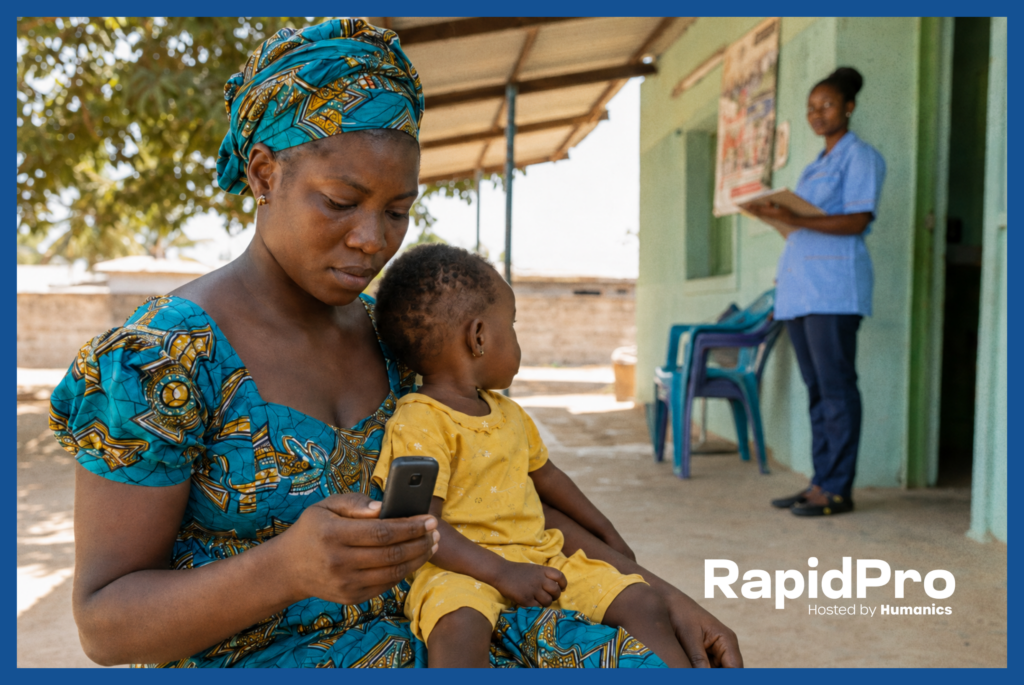
Two-Way SMS for Development Programs
A UNICEF global review of SMS-based health programs found that one-way broadcast campaigns rarely exceed 10–15% response rates. The remaining 85% of messages land, get read, and produce nothing. Program managers keep sending. Beneficiaries keep ignoring.
Two-way SMS for development programs changes that dynamic. Instead of broadcasting reminders into silence, a two-way flow asks a question, waits for the answer, then routes the conversation based on what the beneficiary actually said. Documented deployments using this approach show response rates above 60%.
This article breaks down how interactive messaging works at a technical level, walks through a sample maternal health flow, and compares one-way and two-way SMS across six program metrics that M&E teams track.
Two-way SMS for development programs is a structured messaging approach where the system sends a message, waits for the recipient’s reply, applies conditional logic to classify that reply, and triggers an appropriate follow-up. In practice, this turns a broadcast channel into a conversation.
Why One-Way SMS Hits a Ceiling in Development Programs
Bulk SMS works for one thing: getting a short piece of information in front of a large audience. Appointment reminders, election-day logistics, weather alerts. One message, one direction, no follow-up.
That model breaks down the moment a program needs to collect data, triage a case, or confirm that a beneficiary understood the message. A maternal health campaign that sends “Visit your clinic this week” has no way to know if the mother went. A nutrition screening program that broadcasts “Check your child’s MUAC” cannot record the measurement.
One-way SMS delivers a message but cannot capture a response. The system has no way to know if the beneficiary read, understood, or acted on the information sent.
M&E teams can measure delivery rates, but not outcomes. Was the message read? Did the beneficiary act? No data exists because the system never asked.
All recipients are treated identically. A mother who missed her ANC visit and a mother who attended receive the same next message. No differentiation is possible.
Without automated follow-up, program staff manually track non-respondents across spreadsheets. At 3,000+ beneficiaries, that workload consumes the team.
The Data Gap in Broadcast-Only SMS
An interactive SMS platform closes this gap by turning each message into a data collection point. Every reply generates a structured record that feeds directly into dashboards, DHIS2 instances, or case management tools.
Two-Way SMS for Development: From Broadcast to Structured Dialogue
The shift is mechanical, not philosophical. A one-way system has one component: a sender. A two-way system has four: a sender, a listener, a classifier, and a router. The sender pushes the message. The listener captures the reply. The classifier matches the reply against expected patterns. The router decides what happens next.
That architecture produces conversations. And conversations produce data.
How Two-Way Interactive Messaging Works: Mechanics and Logic
Two-way messaging NGO programs depend on isn’t sophisticated AI. It is a decision tree executed over SMS. Each node in the tree does one of four things: send a message, wait for a reply, evaluate the reply, or trigger an action.
A flow starts when a beneficiary sends a keyword (e.g., “REGISTER” or “HELP”) to a shortcode, or when the system initiates contact from a saved list. The keyword trigger is the entry point.
After sending a question, the system pauses. It waits 1 hour, 24 hours, or 7 days. The timeout is configurable. If no reply arrives, the system sends a reminder, escalates, or closes the case.
The classifier checks the reply against rules. A mother who replies “YES” to a vaccination reminder gets confirmation. A “NO” reply routes to a community health worker for follow-up.
A single flow can span weeks. A TB adherence program checks in daily for six months. Each follow-up fires only if the previous step’s conditions were met, or because they were not.
This is where two-way SMS produces program value. The routing step turns a passive recipient into an active participant whose needs are triaged in real time.
The result is a program that runs without manual intervention but still responds to individual circumstances. A health worker doesn’t monitor a spreadsheet of 3,000 beneficiaries. The system surfaces the 40 who need attention.
Organizations that deploy two-way SMS flows report response rates above 60% in UNICEF-documented programs, compared to 10–15% for one-way broadcast campaigns. The difference is structural: broadcast sends information, interactive messaging collects it.
Building a Two-Way SMS Flow in Practice
Theory is useful. Seeing the mechanics in an actual tool is more useful. RapidPro’s visual flow builder represents each step as a draggable node on a canvas. Program staff, not developers, build and edit flows.
What “Interactive” Looks Like Inside RapidPro’s Flow Builder
A program manager designing a nutrition screening flow drags five nodes onto the canvas. Here’s how a maternal health check-in flow works step by step:
“Hi [Name], did you attend your ANC visit this week? Reply YES or NO.” The system sends a personalized message using stored contact fields.
The system pauses and waits for the beneficiary’s response. If no reply arrives within 24 hours, the flow triggers a reminder message automatically.
Reply = YES → “Great! Your next visit is [date]. We’ll remind you.” Reply = NO → “We understand. [CHW Name] will call you today.” The NO path triggers an alert to the community health worker via SMS.
No reply after reminder? The system escalates the case to the CHW supervisor. A second timeout triggers a direct phone call assignment. No beneficiary falls through the cracks.
Every interaction, reply, escalation, and outcome is logged as structured data. Results push automatically to DHIS2, KoboToolbox, or the program’s M&E dashboard via webhooks.
That entire sequence runs over basic SMS on a feature phone. No app download, no internet connection on the beneficiary’s side. The community health worker in rural Niger uses the same channel a farmer in Bangladesh uses to check crop prices.
Multi-Channel Flows: SMS, WhatsApp, Telegram, and Voice
RapidPro sends the same flow across multiple channels. A beneficiary who starts on SMS and later switches to WhatsApp continues the same conversation. The flow logic doesn’t change. The contact record stays unified.
For programs that serve populations with low literacy, IVR (interactive voice response) runs the same conditional logic through recorded audio prompts. The beneficiary presses “1” or “2” on the keypad instead of typing a reply.
Discover how RapidPro App enables two-way interactive flows across SMS, WhatsApp, and Telegram with a drag-and-drop builder. Explore Features →
One-Way vs. Two-Way SMS: A Metric-by-Metric Comparison
The table below compares one-way broadcast SMS and two-way interactive SMS across six metrics that program managers and M&E teams evaluate when designing beneficiary communication strategies.
| Program Metric | One-Way SMS (Broadcast) | Two-Way SMS (Interactive Flows) |
|---|---|---|
| Response rate | 10–15% (read receipts only, no reply mechanism) | 40–65% in documented UNICEF deployments |
| Data collection | None. Requires separate tools (KoboToolbox, paper forms) | Built into each flow step |
| Case triage | Not possible. All recipients treated identically. | Automated routing based on reply |
| Beneficiary experience | Passive. Receives information, no interaction. | Active. Tailored follow-up per reply. |
| Program staff workload | High. Manual follow-up for non-respondents. | System surfaces only flagged cases |
| Cost per outcome | Low per message, high per confirmed behavior change. | Higher per msg, lower per outcome |
The cost line matters most. A one-way SMS campaign that sends 100,000 messages at $0.02 each costs $2,000 and generates no measurable outcome data. A two-way flow that sends 100,000 messages at $0.04 each costs $4,000 but captures structured data on every respondent. The cost per data point drops from infinity (no data) to $0.07 per recorded interaction.
Connecting Two-Way SMS to Existing Program Systems
Collected data is only useful if it reaches the systems where decisions happen. RapidPro connects to DHIS2, KoboToolbox, and custom APIs through built-in webhooks. When a beneficiary completes a flow, the results push automatically to the M&E dashboard, the health information system, or the case management tool.
For programs already using tools like OpenFn or Zapier, RapidPro fits into the existing integration layer without custom development. A flow result triggers a webhook, the middleware routes it, and the downstream system receives a structured record.
This is what separates an interactive SMS platform from a bulk messaging tool. Bulk tools send messages. RapidPro runs structured conversations and delivers the resulting data wherever it needs to go.
Flow results push directly to DHIS2 health information systems via webhooks. No manual CSV exports, no data entry lag.
SMS survey responses from RapidPro flows sync with KoboToolbox datasets for unified field data analysis alongside tablet-based surveys.
Connect to Salesforce, OpenFn, Zapier, Microsoft Dynamics, or any system that accepts HTTP requests. Token-based authentication, JSON payloads.
✓ One-way SMS caps at 10–15% response rates because it provides no mechanism for beneficiaries to reply.
✓ Two-way SMS uses keyword triggers, wait nodes, conditional logic, and automated routing to create structured conversations over basic SMS.
✓ Documented UNICEF deployments using flow-based two-way messaging report response rates above 60%.
✓ RapidPro’s visual flow builder lets program staff (not developers) design, test, and deploy interactive SMS flows across SMS, WhatsApp, Telegram, and IVR.
✓ Every reply in a two-way flow generates a structured data record that integrates directly with DHIS2, KoboToolbox, and other program systems.
From Broadcast to Conversation
One-way SMS served its purpose when the goal was information delivery. Programs that need to collect data, triage cases, and confirm behavior change need a different architecture.
Two-way SMS for development programs provides that architecture: keyword triggers to start conversations, wait nodes to capture replies, conditional logic to classify responses, and automated routing to direct each case to the right follow-up. The mechanics are straightforward. The impact on program outcomes is measurable.
RapidPro App provides all of this as a managed hosting platform with transparent pricing and no per-message fees on most channels. Program teams deploy interactive flows in days, not months, without provisioning servers or hiring developers. It is the most affordable managed RapidPro hosting on the market.
Turn Your Program Design Into Live, Interactive SMS Flows
Flat pricing. Unlimited contacts and messages. No per-message surprises. RapidPro App is the most affordable managed RapidPro platform on the market, with transparent pricing and zero hidden limits.
Frequently Asked Questions
Common questions from NGO program directors, M&E managers, and digital health advisors evaluating two-way SMS for their communication programs.
What is two-way SMS in development programs?+
Two-way SMS in development programs is a messaging approach where the system sends a message, waits for the beneficiary’s reply, classifies it using conditional logic, and triggers an appropriate follow-up action. It turns broadcast messaging into a structured, data-collecting conversation that runs over basic SMS on any phone.
How does two-way SMS improve response rates over one-way broadcasts?+
One-way broadcasts give recipients no way to respond, capping measurable engagement at delivery confirmations. Two-way SMS asks specific questions and routes follow-ups based on answers, which increases engagement because the beneficiary receives personalized responses. UNICEF programs using this approach report 40–65% response rates compared to 10–15% for broadcast-only campaigns.
Do beneficiaries need a smartphone for two-way SMS?+
No. Two-way SMS flows run on any phone that can send and receive text messages, including basic feature phones. This is the reason SMS remains the primary channel for development programs in low-connectivity settings across Sub-Saharan Africa and South Asia.
Can two-way SMS integrate with DHIS2 and other health information systems?+
Yes. Platforms like RapidPro include built-in webhook support that pushes structured flow results to DHIS2, KoboToolbox, and custom APIs in real time. Each completed flow generates a data record that routes automatically to the program’s M&E dashboard or case management system.
What is the difference between bulk SMS and interactive SMS for NGOs?+
Bulk SMS sends the same message to an entire list with no reply mechanism. Interactive SMS sends a message, captures the recipient’s response, applies conditional logic, and triggers a tailored follow-up. The difference is structural: bulk SMS is a megaphone; interactive SMS is a conversation. For NGOs, that means interactive SMS collects data and triages cases while bulk SMS only broadcasts information. Read more about interactive SMS vs. bulk SMS.
Related Reading
RapidPro App Features: Flow Builder, Channels, and Integrations
RapidPro Integration API: Connecting to DHIS2, KoboToolbox, and More