
When the Rain Doesn’t Wait: How a Flood Early Warning System Powered by RapidPro App Could Save Lives in Ghana
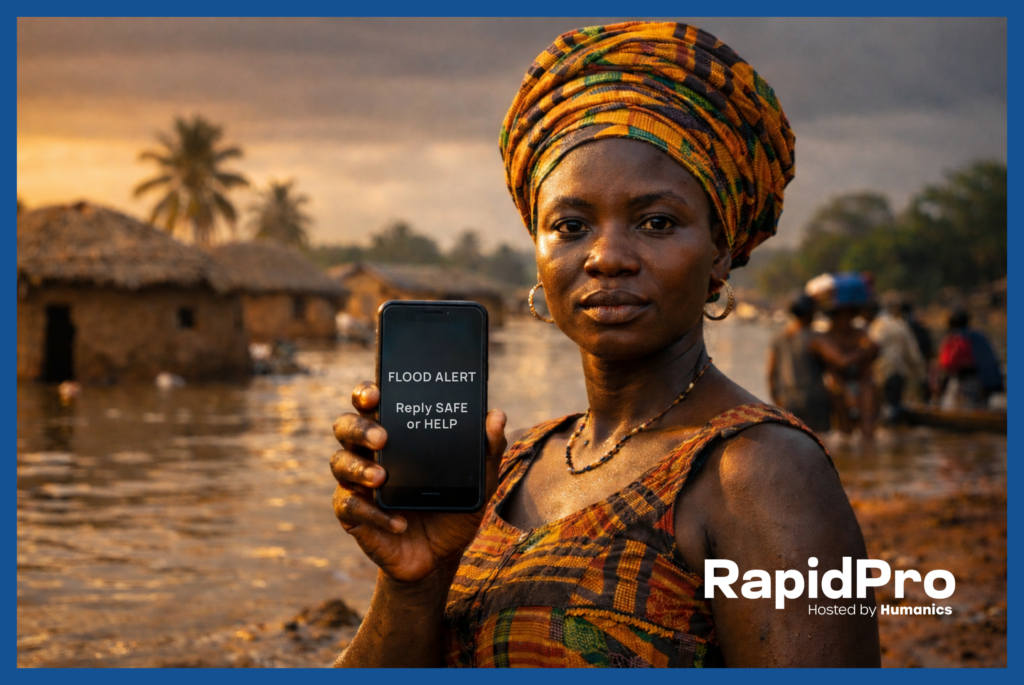
Every rainy season in Ghana, the same tragedy unfolds. Rivers overflow. Communities in the Northern, Savannah, and Greater Accra regions are submerged within hours. And yet, thousands of citizens receive no warning, or receive it far too late to act. The 2024 Accra flash floods displaced thousands of residents and exposed a critical, systemic failure: the absence of a reliable, scalable flood early warning system capable of reaching citizens directly, in real time, through the channels they already use.
This is not a technology problem. Ghana has mobile penetration. Ghanaians use SMS. WhatsApp is ubiquitous. The gap lies in the infrastructure that connects government agencies, emergency responders, and vulnerable communities into a single, coordinated communication loop. That infrastructure, deployable today, at scale, and at a fraction of the cost of traditional systems, already exists. It is called RapidPro App.
This article presents a hypothetical yet operationally grounded scenario: how a dedicated RapidPro instance, once deployed by Ghanaian government agencies, could serve as a life-saving emergency SMS alert platform and communication backbone during seasonal flooding events.
Citizens reachable via SMS in a single broadcast campaign
Time to trigger a geo-targeted alert campaign at scale
Data required on the recipient’s device — SMS works on any basic phone
Ghana’s Flood Crisis: A Communication Failure as Much as a Climate One
When floodwaters rise, information must travel faster than the current. In Ghana, that race is consistently lost. The National Disaster Management Organisation (NADMO) issues warnings through radio, television, and social media channels that are inherently broadcast-only, unverified, and unable to reach citizens without electricity, internet, or literacy in real time.
In the 2024 flooding events across Accra and the Oti Region, emergency response was severely hampered by the inability to systematically collect ground-level feedback. Agencies could not confirm which communities had been reached, which roads were impassable, or where rescue operations were most urgently needed. Information flowed in one direction: downward. And it rarely reached the last mile.
Why Traditional Channels Fall Short in Crisis Scenarios
- ●
Radio and TV require power, reach, and active listening, three conditions rarely met during a rapidly escalating flood event. - ●
Social media platforms depend on internet connectivity and are inaccessible to a significant portion of rural and peri-urban populations. - ●
Manual hotlines are overwhelmed within minutes of a crisis and produce no structured, actionable data. - ●
One-way alerts offer no mechanism for citizens to report their location, request assistance, or confirm receipt of critical information.
“
A flood warning that cannot be confirmed, tracked, or responded to is not a warning system; it is a broadcast. RapidPro App transforms that broadcast into a conversation.
What RapidPro App Brings to Flood Early Warning Communication
RapidPro App is a fully managed, enterprise-grade hosting solution built on the open-source RapidPro platform, the same technology trusted by UNICEF, WHO, and dozens of national governments for large-scale citizen engagement. Unlike raw open-source deployments, RapidPro App removes all technical complexity, providing government agencies and NGOs with a secure, immediately operational instance at transparent, affordable pricing.
For Ghana’s emergency communication ecosystem, this translates into one decisive advantage: speed of deployment. A RapidPro instance can be configured and operational within days, not months, making it uniquely suited to pre-crisis preparation and rapid activation when flood risk escalates.
A Flood Early Warning System Built for the Last Mile
In a flood early warning scenario for Ghana, government agencies such as NADMO or the Ghana Meteorological Agency could deploy the following capabilities through a single RapidPro instance:
Send flood warnings and evacuation instructions directly to contacts in specific districts, no internet required on the recipient’s device.
Citizens reply with a keyword — “HELP”, “SAFE”, “EVACUATED” — triggering automated workflows that log status or escalate distress signals.
For urban populations with data access, the same alert flows run natively on WhatsApp, no duplication of effort required.
Every citizen interaction is captured in real time, enabling coordinators to identify the highest-risk zones and prioritise ground team deployment.
A Hypothetical Deployment: Ghana Flood Response Step by Step
The following scenario is hypothetical but operationally grounded in RapidPro App’s verified capabilities. Imagine NADMO activates its RapidPro instance as the Ghana Meteorological Agency issues a Severe Flood Risk alert for the Oti and Northern Regions.
NADMO’s coordinator activates a pre-built RapidPro flow. Within seconds, geo-targeted SMS messages are dispatched to over 200,000 registered contacts across at-risk districts: evacuation instructions, shelter coordinates, and a single-keyword reply prompt.
Residents reply via SMS. RapidPro’s automated flow categorises responses in real time: “SAFE” triggers a confirmation log; “HELP” triggers an escalation flag sent directly to the nearest district rescue team; no response after 30 minutes triggers an automatic follow-up message.
Emergency coordinators access a live dashboard showing response rates by district, the number of distress signals received, and areas with the lowest confirmation rates, identifying where ground teams must be deployed first.
Updates on rising water levels, road closures, and shelter availability are pushed to affected populations in successive automated messages. Feedback loops continue until the threat subsides.
All collected data feeds into a structured post-event report: community reach rates, response times, uncontacted populations, and emerging needs, informing future preparedness investments and donor reporting.
Every component described above is a native RapidPro App feature, deployable today, on infrastructure that Ghanaian mobile users already carry in their pockets.
Comparing Emergency Communication Approaches: Why RapidPro App Leads
Understanding how different communication tools address Ghana’s flood emergency needs clarifies the strategic advantages of a purpose-built platform over fragmented workarounds.
| Approach | Two-Way | Works Without Internet | Last-Mile Suitability |
|---|---|---|---|
| Radio / TV Broadcast | No | Needs Power | Poor |
| Social Media Alerts | Partial | Needs Internet | Limited |
| Manual Hotline | Yes — but unscalable | Yes, but limited | Limited |
| WhatsApp Only | Yes | Needs Internet | Urban Only |
| RapidPro App (SMS + WhatsApp) | Yes — automated at scale | Yes — SMS Native | Excellent |
Beyond Floods: A Scalable SMS and WhatsApp Government Communication Platform
The value of deploying an SMS and WhatsApp government communication platform like RapidPro App extends well beyond single-event crisis response. For agencies such as the National Commission for Civic Education (NCCE) or the Ministry of Food and Agriculture (MOFA), a standing RapidPro instance creates a durable digital infrastructure for year-round citizen engagement:
- ✓
Citizen Feedback Collection: Gather structured responses on public service delivery via SMS surveys across all regions - ✓
Administrative Updates: Share benefit distribution schedules, service availability, and process changes in real time - ✓
Multi-Language Broadcasting: Disseminate health alerts and civic information in local languages via AI-assisted translation - ✓
Measurable Engagement: Built-in analytics turn every campaign into structured evidence for reporting and programme improvement
When institutions invest in this kind of infrastructure before a crisis, they are not simply purchasing a messaging tool. They are building the trust and technical readiness required to respond effectively when it matters most. The flood season does not wait for procurement cycles.
“
The ideal flood early warning system should feel like a reflex, not a reaction. RapidPro App gives institutions the infrastructure to act before the water rises, and the data to rebuild smarter after it recedes.
The Infrastructure of Resilience Is Already Within Reach
Ghana’s flood vulnerability is not going to diminish. Climate projections point to more frequent and more intense seasonal flooding across West Africa well into the coming decades. What can change, and change immediately, is the capacity of institutions to communicate with the people they serve when those people need it most.
A flood early warning system is only as effective as its last-mile reach. RapidPro App provides reach: through SMS, WhatsApp, automated flows that do not require coordinators to make thousands of phone calls, and live dashboards that transform citizen responses into actionable intelligence for emergency responders on the ground.
RapidPro App is a turnkey, fully managed hosting solution designed for large enterprises, NGOs, and government agencies ready to deploy interactive communication systems at scale, securely, rapidly, and affordably. Our transparent pricing and 24/7 expert support ensure your team is ready long before the next rainy season begins. The technology is ready. The infrastructure is deployable. The only variable is the decision to act.
Build Ghana’s Flood Early Warning Communication Infrastructure, Starting Today
RapidPro App delivers enterprise-grade emergency communication at a transparent, affordable price. Unlimited contacts, messages, channels, and campaigns. No hidden fees. 24/7 expert support included. All the power you need, none of the complexity you don’t.
Frequently Asked Questions
Everything you need to know about deploying a flood early warning system and emergency SMS alert platform in Ghana with RapidPro App.
What is a flood early warning system, and how could it work in Ghana?
+
A flood early warning system is a coordinated infrastructure that monitors flood risk and communicates alerts to at-risk populations before a disaster strikes. In Ghana, such a system would ideally integrate meteorological data from the Ghana Meteorological Agency with a mass communication platform, like RapidPro App, capable of dispatching geo-targeted SMS and WhatsApp alerts to citizens in vulnerable districts, collecting their responses in real time, and routing distress signals to emergency responders automatically. The key differentiator from traditional broadcasting is two-way communication: citizens don’t just receive warnings, they can actively confirm status, request help, and provide ground-level information that improves response coordination.
How does RapidPro App function as an emergency SMS alert platform?
+
RapidPro App enables government agencies and humanitarian organisations to design automated communication flows that broadcast emergency SMS alerts to thousands of contacts simultaneously, collect keyword-based replies, and escalate critical responses to designated teams, all without manual intervention. The platform’s no-code flow designer allows non-technical staff to build and activate these campaigns within minutes. Its multi-channel architecture means the same flows run across both SMS and WhatsApp, maximising reach across rural and urban populations alike, with no duplication of effort required.
Which Ghanaian agencies could deploy a RapidPro instance for flood response?
+
Agencies with a direct mandate in disaster preparedness, citizen engagement, and public service delivery stand to benefit most. These include NADMO (National Disaster Management Organisation), the Ghana Meteorological Agency, NCCE (National Commission for Civic Education), MOFA (Ministry of Food and Agriculture), and district assemblies in flood-prone regions, including the Northern, Savannah, Upper East, Upper West, and Oti regions. International partners such as UNICEF Ghana, UNDP, and the Red Cross could also leverage a shared or coordinated RapidPro instance for a unified humanitarian response across multiple organisations.
Is RapidPro App suitable for rural communities with low connectivity in Ghana?
+
Yes, this is one of RapidPro App’s most significant advantages. The SMS channel operates entirely independently of internet connectivity on the citizen’s device. A recipient needs only a basic mobile phone to receive alerts and respond with a keyword reply. This makes RapidPro App uniquely effective for reaching populations in Ghana’s Northern, Savannah, Upper East, and Upper West regions, where smartphone and data penetration remain significantly lower than in Greater Accra. The platform’s USSD and voice channel options further extend reach to populations with limited literacy or very basic handsets.
What is the difference between RapidPro open source and RapidPro App?
+
RapidPro is an open-source communication platform originally developed by UNICEF. Deploying a raw open-source RapidPro instance requires substantial technical expertise, dedicated server infrastructure, and ongoing maintenance by a skilled IT team, a significant barrier for many government agencies and NGOs. RapidPro App is a fully managed, hosted version of the platform, meaning organisations receive a ready-to-use, secure, enterprise-grade RapidPro instance with no server management required. It is the fastest, most affordable, and most operationally reliable path to deploying RapidPro at scale, with transparent annual pricing, 24/7 expert support, and dedicated onboarding included from day one.
Related Reading