
How a Drought Early Warning System Can Save Thousands of Lives in Zambia
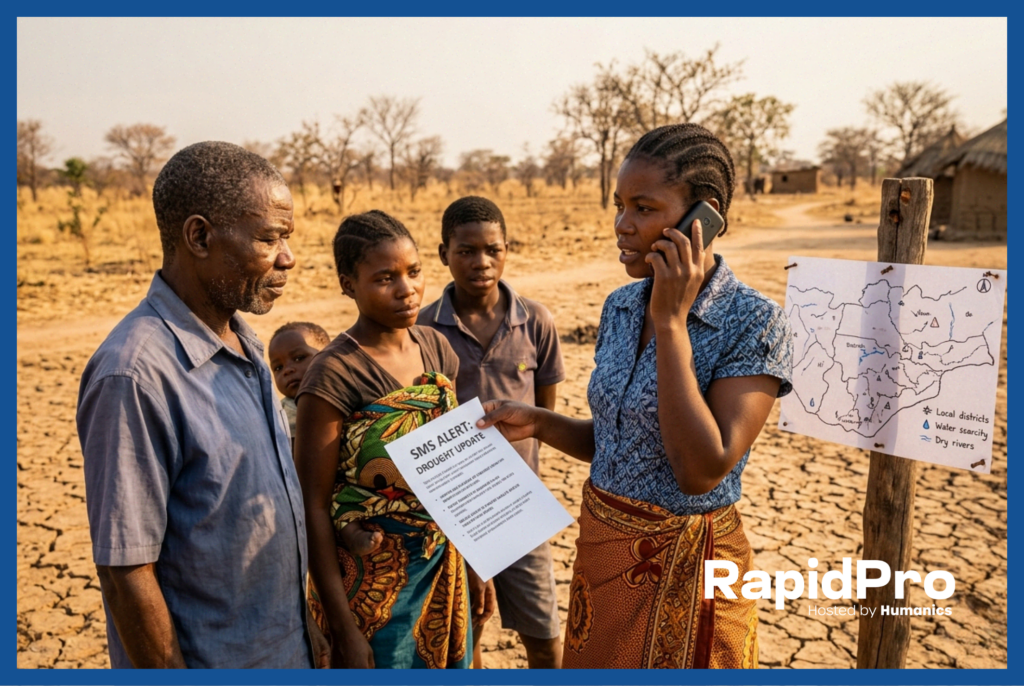
Drought Early Warning System
Over 2.8 million Zambians faced acute food insecurity during the 2023–2024 El Niño-induced drought, one of the most severe climate shocks the region has experienced in thirty years. Yet across the most affected districts, community coordinators were still relying on phone calls, handwritten registers, and word-of-mouth to reach vulnerable households.
A properly deployed drought early warning system changes that equation entirely. When relief organisations can broadcast targeted alerts, collect real-time community data, and automate coordination workflows through a single platform, they shift from reactive crisis management to proactive response.
This use case explores how a RapidPro.App-hosted instance could empower Zambian relief teams to reach tens of thousands of households via SMS and IVR, close critical communication gaps, and generate live dashboards that accelerate resource allocation when every hour matters. This is a hypothetical scenario, designed to illustrate what becomes operationally possible with a managed RapidPro deployment.
A drought early warning system is an integrated communication and data-collection infrastructure that detects early drought indicators, triggers targeted alerts, and orchestrates multi-agency response protocols. In practice, it connects national meteorological data with last-mile community outreach, transforming raw climate signals into actionable field intelligence that coordinators can act on within hours.
The Communication Gap That Costs Lives: Humanitarian SMS Alerts in Africa
Why Fragmented Outreach Delays Life-Saving Action
Across Sub-Saharan Africa, humanitarian SMS alerts are widely recognised as the fastest and most accessible channel for reaching affected populations, especially in low-connectivity rural areas where smartphone penetration remains below 30%.
Yet most organisations face the same structural barriers. According to OCHA, delays of 48 to 72 hours in early warning dissemination can significantly worsen food insecurity outcomes in rapid-onset drought scenarios.
Manual broadcast processes that take hours per district, with no confirmation of delivery.
No two-way feedback channel to confirm message receipt or capture household-level needs.
Siloed data scattered across spreadsheets, WhatsApp groups, and paper forms.
Zero visibility into who received alerts, and who remained unreached during the crisis window.
How RapidPro Closes the Gap
RapidPro, the open-source platform originally developed by UNICEF, is built specifically to solve these coordination challenges. Its visual flow builder allows non-technical staff to design automated SMS and IVR workflows in hours, not weeks.
With RapidPro.App handling the infrastructure, hosting, security, and technical maintenance, relief organisations can focus entirely on designing their response logic, not managing servers.
Discover how RapidPro.App enables rapid deployment of humanitarian communication systems with zero infrastructure overhead.
Request Your Demo →
Building a Community Needs Assessment Framework at Scale
Designing Two-Way SMS Workflows for Field Data Collection
One of the most underutilised capabilities in crisis response is structured community needs assessment via SMS, using two-way messaging to collect household-level data directly from affected populations. In the Zambia scenario, a RapidPro.App-hosted instance powers the following response arc:
45,000 households in three drought-affected provinces receive an SMS alert in Nyanja, Bemba, and English, automatically segmented by district and language using RapidPro contact groups.
A branching IVR flow invites community members to report food stock levels, water access status, and livestock condition using simple numeric keypad inputs. No smartphone required.
All responses feed into a live RapidPro dashboard, allowing coordinators to map vulnerability hotspots by GPS-tagged ward boundary in real time.
A second automated SMS flow reaches non-respondents and households flagged as high-risk, closing the gap left by passive broadcast methods.
Weekly check-in flows track recovery indicators, enabling adaptive resource reallocation as conditions evolve across the affected provinces.
A Drought Early Warning System That Speaks the Local Language
Language is infrastructure. According to best practice guidelines from GSMA’s Mobile for Humanitarian Innovation programme, localised messaging increases response rates by up to 65% compared to English-only broadcasts.
RapidPro’s multi-language support is fully accessible through a RapidPro.App managed deployment allows coordinators to configure language preference at the individual contact level, run parallel flows in multiple languages simultaneously, and maintain consistent message integrity across all linguistic variants. This capability is a core function of RapidPro, ready to activate from day one.
A community that cannot report its needs in its own language is a community that cannot be heard. Multilingual SMS flows are not a feature, they are a prerequisite for equitable humanitarian response.
From Alert Broadcast to Real-Time Dashboard in 72 Hours
How RapidPro.App Powers the Full Response Lifecycle
The Zambia use case demonstrates a full-cycle communication architecture that most organisations struggle to assemble from disparate tools. With RapidPro.App, the entire stack, hosting, monitoring, backups, uptime SLAs, and user access management are handled as a managed service.
| Response Phase | Channel | RapidPro Feature |
|---|---|---|
| Early warning broadcast | SMS + IVR | Bulk messaging with group targeting |
| Community data collection | Two-way SMS | Branching survey flows |
| Field coordinator alerts | SMS + Web | Flow triggers + webhook integration |
| Real-time reporting | Web dashboard | Contact analytics + run results export |
| Escalation routing | IVR | Conditional logic + escalation flows |
Why Managed Hosting Changes Operational Reality
Self-hosting RapidPro requires dedicated DevOps capacity, ongoing security patching, and robust infrastructure, resources that most NGOs and government DRR units do not have in-house. RapidPro.App eliminates that barrier.
One of the most accessible managed RapidPro offers on the market, with no hidden costs.
Data sovereignty, encrypted storage, and role-based access control built in.
Deployments operational within days, not months, are critical in rapid-onset drought scenarios.
Your team stays focused on the mission while experts manage all technical operations.
✓ A drought early warning system powered by RapidPro enables automated alert broadcasting, structured community needs assessments, and real-time dashboards through a single platform.
✓ RapidPro.App removes the infrastructure barrier by providing a fully managed, enterprise-grade hosting solution designed for NGOs, UN agencies, and government disaster risk units.
✓ Organisations that deploy RapidPro through a managed provider consistently activate faster, collect more reliable field data, and coordinate more efficiently than those relying on fragmented manual processes.
✓ Localised, two-way SMS workflows dramatically increase community engagement and data completion rates in low-connectivity rural contexts across Sub-Saharan Africa.
Launch Your Drought Response System in Days With Zero Infrastructure Overhead
RapidPro.App is the most affordable and transparent managed RapidPro hosting solution on the market, purpose-built for NGOs, UN agencies, governments, and public health organisations. Automated alert flows, real-time dashboards, multi-language IVR, and full donor reporting. We handle every technical detail so your team can focus entirely on the mission.
Frequently Asked Questions
Everything NGOs, governments, and humanitarian tech teams need to know about deploying a drought response communication system with RapidPro.App.
What is a drought early warning system, and how does it work?
+
A drought early warning system is an integrated platform that monitors climate indicators, triggers automated community alerts, and coordinates multi-agency response workflows. It works by connecting meteorological data sources with last-mile communication channels, typically SMS and IVR, to reach affected populations before a crisis reaches its peak. Modern systems like RapidPro enable two-way data collection, meaning communities can report needs, not just receive information.
How can SMS be used for humanitarian alerts in Africa?
+
SMS remains the most reliable channel for humanitarian alerts across Sub-Saharan Africa because it works on basic feature phones, requires no internet connectivity, and reaches remote communities instantly. Organisations use platforms like RapidPro to send bulk messages, segment recipients by geography or vulnerability profile, and run automated follow-up flows, all without manual intervention from field staff.
What is a community needs assessment in disaster response?
+
Community needs assessment in disaster response is the structured process of collecting household-level data on food security, water access, health status, and livelihoods directly from affected populations. Digital tools like RapidPro enable this via automated SMS surveys, allowing organisations to aggregate and analyse data in real time and prioritise resource allocation based on actual reported needs.
Why do organisations use RapidPro for crisis communication?
+
RapidPro is purpose-built for large-scale, multi-channel crisis communication. Its visual flow builder allows non-technical staff to design complex messaging workflows, its multi-language support ensures inclusive reach, and its open-source architecture integrates with existing humanitarian data systems. Managed deployments through providers like RapidPro.App adds enterprise-grade reliability and security without requiring internal DevOps capacity.
How long does it take to deploy a RapidPro communication system?
+
With a managed deployment through RapidPro.App organisations can have a fully operational RapidPro instance, configured, secured, and ready for contact import, within a matter of days. This contrasts sharply with self-hosted deployments, which typically require weeks of infrastructure setup. The faster activation window is critical in rapid-onset drought scenarios where the first 72 hours determine response quality.
Related Reading
RapidPro.App Features: Two-Way SMS, WhatsApp, USSD & Real-Time Campaign Dashboards
Transparent, Affordable Managed RapidPro Hosting for Governments, NGOs & Public Health Agencies
How Governments and Organizations Are Transforming National Communication With RapidPro.App
Malaria Prevention in Tanzania: How Targeted SMS Campaigns Deliver Measurable Public Health Impact
Managed RapidPro Hosting for Government Programs: National Communication at Scale