
Use Case: Community Feedback System for Scalable Engagement in Ethiopia’s Humanitarian Response
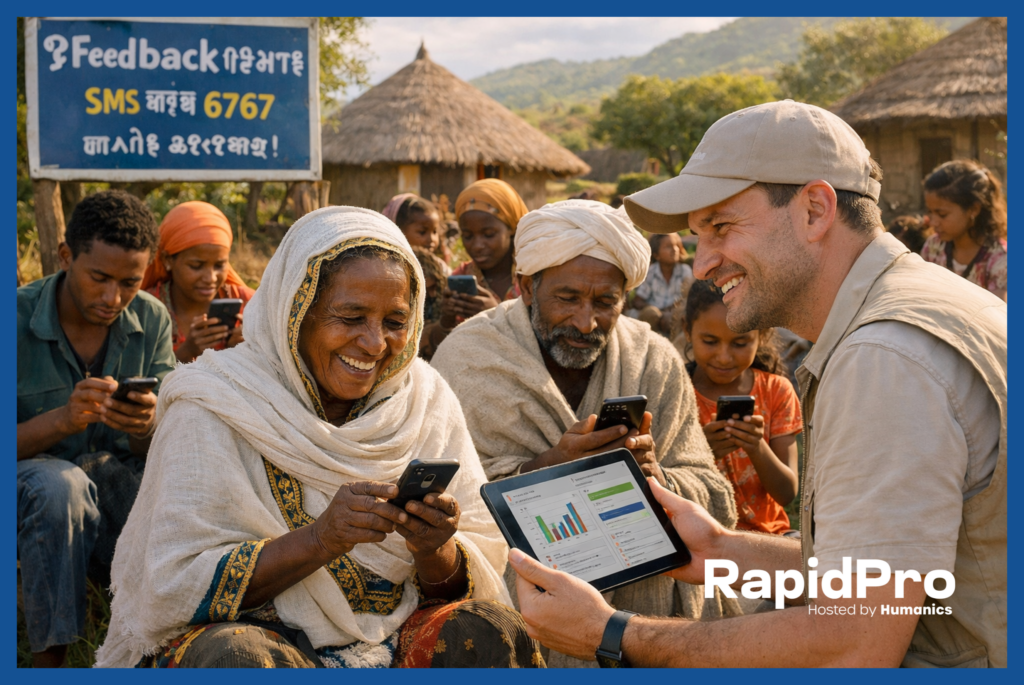
In Ethiopia’s ongoing humanitarian crises, marked by conflict, drought and mass displacement, organisations often lack reliable channels to hear directly from affected communities. As of 2024, 21.4 million people in Ethiopia need life-saving assistance. This includes roughly 4.4 million internally displaced persons (IDPs) living in dispersed camps and host communities. Recent conflicts have “left communities in dire need of support,” displacing thousands across regions like Afar, Amhara, Oromia and Tigray.
In these complex environments, the voices of women, men and children often go unheard by aid providers, limiting the effectiveness of relief efforts. A robust community feedback system, one that leverages mobile tools and two-way engagement, could bridge this gap, turning passive recipients into active partners in decision-making. By tapping into SMS, voice and chatbot channels, humanitarian actors can collect real-time feedback on food, health and shelter needs, even in low-connectivity areas. This digital approach promises faster, more reliable insights than traditional suggestion boxes or ad-hoc surveys, helping agencies adapt programs quickly to community priorities.
- OCHA reports 21.4M people need aid, including 4.4M IDPs and 930,000 refugees in Ethiopia.
- Multiple conflict zones (Afar, Amhara, Oromia, Tigray) and climate shocks strain basic services.
- Ground-level feedback remains fragmented: NGOs use toll-free lines, suggestion boxes and community meetings, which can be slow or inaccessible.
Such conditions demand innovative feedback mechanisms at scale. A digital community feedback system can provide two-way communication by combining SMS surveys, interactive voice response (IVR) and chatbots. When properly implemented, for example, through a managed platform, these tools enable constant dialogue with displaced families and host communities in their local languages.
Organisations can set up automated flows to ask key questions about food security, health access or protection issues. As responses come in, integrated dashboards would highlight emerging trends, hotspots of need, and potential risks. In this way, aid actors transform scattered data into actionable intelligence, strengthening both program effectiveness and accountability.
Ethiopia’s Humanitarian Challenges and Displaced Communities
Ethiopia’s situation is characterised by multi-faceted crises that have repeatedly forced populations to move. The United Nations 2024 Humanitarian Needs Overview notes that 21.4 million people in Ethiopia now require humanitarian assistance. OCHA estimates that of these, 15.5 million are targeted for urgent support under the Humanitarian Response Plan, including 4.4 million IDPs and over 10 million school-age children needing educational services. Many of these children, 8.8 million by one count, are out of school due to conflict and displacement. Regional clashes have created pockets of highly vulnerable communities; the World Bank highlights that Ethiopia’s conflict-affected regions (Afar, Amhara, Benishangul-Gumuz, Oromia, Tigray) “host large numbers of internally displaced peoples”.
These crises have generated both internal displacement and refugee influx. Ethiopia hosts nearly 1 million refugees from neighbouring countries (South Sudan, Somalia, Eritrea), adding pressure on basic services. Meanwhile, humanitarian agencies are stretched thin trying to rebuild infrastructure and deliver aid. In such environments, traditional monitoring is difficult: roads may be impassable, and field teams cannot easily gather community input across multiple dispersed sites. Moreover, affected populations often lack confidence that their feedback will lead to change. The scale of the challenge, millions in need across rugged terrain, calls for innovative approaches that can capture community perspectives at scale and speed.
Challenges of Citizen Feedback Mechanisms
Current feedback channels in Ethiopia are often manual, localised, or project-specific. NGOs and UN agencies might distribute suggestion boxes at service centres or conduct community meetings and door-to-door questionnaires. However, these methods face limitations. Physical suggestion boxes can be inaccessible or subject to local power dynamics; face-to-face surveys and focus groups are labour-intensive and slow to analyse. Language diversity and literacy gaps (with dozens of local languages spoken) further complicate outreach. As one local NGO (PIN Ethiopia) notes, setting up a Community Feedback & Response Mechanism (CFRM) is crucial for accountability, but it requires intensive effort to build trust and maintain confidentiality. PIN Ethiopia’s CFRM uses toll-free hotlines, SMS and suggestion boxes, translating messages into five local languages to encourage participation.
Despite these efforts, such systems remain fragmented. Real-time two-way communication is rare. Humanitarian stakeholders have called community feedback “a vital component of continuous improvement,” yet many programs lack a unified digital platform to consistently collect and act on feedback. When collected, feedback data often sits in silos or reports and is not shared promptly across agencies. This weak interoperability can result in duplicated efforts and missed trends. In crisis settings, where needs and priorities shift rapidly, delays or silos in understanding community concerns can undermine trust. The result: communities feel unheard, and aid effectiveness suffers.
Digital Feedback Systems and Citizen Engagement
Digital platforms like RapidPro, an open-source communication engine, offer a powerful alternative. In essence, a digital community feedback system uses mobile technology to create a continuous loop of information between citizens and aid providers. Through SMS, voice calls, WhatsApp or other apps, organisations can push out short surveys, announcements or reminder messages to community members. Individuals respond with structured data (e.g. numeric choices, coded replies) that the system automatically logs. Crucially, the platform enables two-way flow: respondents can also ask questions or send issues back to the organisation. All interactions are then aggregated on a dashboard or database, giving program staff near-real-time visibility into community sentiment and emerging issues.
Organisations like UNICEF have widely adopted such systems. In 2020, 113 countries reported using real-time digital information tools, with 43% of UNICEF country offices employing RapidPro for data collection and outreach. In fact, U-Report Ethiopia, a youth engagement platform run by UNICEF, relies on RapidPro’s infrastructure to host poll responses and chatbot interactions. This platform sends polls via SMS, Facebook and WhatsApp to engage young Ethiopians on topics from education to health. The privacy policy of U-Report Ethiopia explicitly notes that “we use a trusted third party, RapidPro, to host your answers to polls”, reflecting the confidence of UNICEF in RapidPro’s scalability and data security.
The flexibility of RapidPro means it can serve as a humanitarian data collection backbone. By leveraging various channels (SMS, USSD, voice, social messaging), agencies can tailor outreach to context. In Ethiopia’s rural and urban areas alike, basic feature phones are ubiquitous. A text-based survey can thus reach communities where the internet is unreliable. As RapidPro’s documentation explains, its SMS gateway support (“via Twilio & others”) offers “global two-way texting that reaches users even on basic phones”. This no-code platform also includes AI-powered translation for flows, which could convert questions automatically into Amharic, Oromiffa or Somali, further lowering language barriers.
Implementing a Community Feedback System with RapidPro App
RapidPro App provides a turnkey hosted solution to deploy such feedback systems at scale. For agencies without extensive tech teams, RapidPro App manages the underlying servers and security, allowing program staff to focus on content and analysis.
Key features include:
- Automated SMS/USSD Surveys: Quickly create multi-step questionnaires. For example, organisations could text displaced families to ask about food availability (“Is your family food secure this week? Reply 1 for Yes, 2 for No”) or water source issues. RapidPro’s drag-and-drop flow designer enables conditional logic, so follow-up questions adapt based on prior answers.
- Two-Way Communication: Beneficiaries can respond or send concerns back through the same channel. RapidPro supports inbound SMS, allowing people to text keywords or open-ended feedback. The platform can also route complaints or requests to field teams automatically.
- Multi-Channel Outreach: Beyond SMS, RapidPro App can broadcast messages via voice calls or apps like WhatsApp and Telegram. This extends reach to community members who prefer chat apps. All channels feed into the same dashboard for unified monitoring.
- Real-Time Analytics Dashboard: As responses flow in, staff see live analytics, response rates, geographies, demographic breakdowns, and a summary of key issues. RapidPro App’s analytics help identify hotspots (e.g. a surge of “shelter needed” replies in a certain region) and track trends over time.
- Language Support: RapidPro’s AI-assisted translation can auto-translate survey flows to local languages. This means an NGO can design one survey and deploy it in Amharic, Tigrinya or Somali without separate coding, greatly expanding accessibility.
- Secure, Scalable Infrastructure: The hosted platform ensures messages to thousands of contacts per day without downtime. RapidPro App is “trusted by NGOs and public institutions operating mission-critical communication systems”. Data protection safeguards are in place, as evidenced by UNICEF’s use of RapidPro for sensitive polls.
By centralising citizen feedback through RapidPro App, humanitarian actors gain several advantages. They can prioritise interventions based on aggregated community needs: for instance, if multiple districts report deteriorating water access, agencies can redirect hygiene kits or water trucking there. Quick pulses can track if interventions are working: after distributing food supplies, an SMS check-in can confirm receipt and adequacy.
Importantly, donors and authorities see data-driven evidence of impact: surveys and dashboards provide quantifiable results that feed into reports, satisfying accountability requirements.
Benefits of Digital Feedback for Program Effectiveness
A well-designed community feedback system fundamentally improves the aid cycle:
- Adaptive Programming: Real-time community input lets responders pivot quickly. Rather than waiting months for a paper reportback, NGOs see issues instantly and can adjust camp services or aid commodities accordingly. This agility is crucial when new crises or locust swarms hit.
- Stronger Accountability: Knowing that messages will reach decision-makers encourages trust. Communities appreciate agencies that regularly ask for their opinions. As PIN Ethiopia noted, emphasising the importance of feedback during program launches, “helps individuals feel assured that we respectfully handle their feedback”. A digital channel amplifies this reach.
- Reduced Cost and Scale: Digital surveys can replace expensive field monitoring trips. In one UNICEF example (outside Ethiopia), daily SMS check-ins with vaccination teams helped monitor millions of children. In Ethiopia, even a few thousand SMS responses can signal countrywide trends at a fraction of in-person effort.
- Data-Driven Coordination: Shared digital data on needs can align multiple agencies. If UN clusters (health, WASH, etc.) agree to funnel community feedback into a common RapidPro instance, they can coordinate resources more tightly. Trends become visible not just to one NGO but to the wider response.
- Risk Mitigation: Early warning is possible through feedback. For example, if surveys detect rising reports of violence or market price spikes, agencies can preemptively enhance protection services or food assistance.
These benefits illustrate why global actors are embracing such systems. In 2020, UNICEF reported that over 40% of countries used U-Report (RapidPro’s youth engagement platform) for “youth/citizen engagement at scale”. This demonstrates that with the right tools, affected people anywhere, including Ethiopia, can be connected to decision-makers like never before.
Conclusion
Digital community feedback systems are no longer a luxury in humanitarian action but a necessity to truly engage communities and improve outcomes. By deploying RapidPro App, NGOs, governments and donors working in Ethiopia can stand up a scalable, secure feedback platform without getting bogged down in technical complexity.
This lets humanitarian teams focus on their core mission, relieving suffering and building resilience, while RapidPro App handles the infrastructure. With features like SMS surveys, multilingual messaging, real-time dashboards and robust security, RapidPro App offers a turnkey solution for accountability and needs assessment.
Request your demo today to see how RapidPro App can transform your community engagement strategy. Empower your teams with a proven system that listens to every community voice at scale, building trust and making aid more effective. Our solution is tailored for large NGOs, governments and donors seeking a scalable feedback system with transparent pricing. Focus on your mission while we ensure reliable two-way communication with the communities you serve.
FAQ
What is a community feedback system? A community feedback system is a structured approach for gathering input and opinions from community members. In humanitarian contexts, it typically involves tools like surveys, hotlines or apps that let affected people share their needs and satisfaction with services. A digital community feedback system uses mobile and online channels (e.g. SMS, WhatsApp, IVR) to collect responses in real time, enabling organisations to respond faster to community concerns.
How do citizen feedback mechanisms improve humanitarian programs? Citizen feedback mechanisms (e.g. mobile surveys, helpdesks, community fora) ensure two-way communication between aid providers and recipients. They let communities highlight gaps (such as food shortages or clinic issues) and suggest solutions. By integrating this feedback, organisations can adapt programs to actual needs, increase transparency and build trust. For example, regular SMS check-ins can reveal if distributed food is sufficient or if refugees need additional support, thereby improving program effectiveness and accountability.
Can digital feedback systems work in areas with low connectivity? Yes. Digital feedback solutions like SMS-based surveys are designed for low-resource settings. Even where smartphone or internet access is limited, most people have basic mobile phones. Platforms like RapidPro support two-way SMS via standard gateways, meaning messages can be sent and received on any phone. No internet is required for the end-user. Additionally, IVR (interactive voice response) and USSD can reach people without texting. These technologies enable feedback collection across Ethiopia, including rural and conflict-affected zones.
How does RapidPro App support humanitarian data collection? RapidPro App is a managed hosting service for the RapidPro platform. It allows organisations to build and run SMS and chatbot workflows without handling servers. For data collection, you can use RapidPro App to deploy multilingual SMS or USSD surveys to thousands of contacts. All incoming responses are automatically stored and visualised on dashboards. As a turnkey solution, RapidPro App provides secure, scalable infrastructure and analytics so aid agencies can focus on the content of their surveys and how to act on the data, rather than on technical setup.